
Apophenia
A psychological trait shared by the mentally healthy and mentally ill

Apophenia is a fascinating example of how a psychological trait innate to humans can be both beneficial and harmful. It can be an essential part of healthy functioning while also playing a role in mental illness.
Humans are information processors. We receive sensory input, and our brains process it to form perceptions and judgments. In many cases, these educated guesses— That’s a dog in the distance, That stranger looks friendly— are accurate. In many cases, they are wrong. As we walk closer, we may realize that the dog is actually a raccoon or even a small bush. After interacting with someone, we may discover that the friendly stranger is rude.
The term apophenia, coined by German psychiatrist Klaus Conrad, refers to the tendency to perceive connections and meaningful patterns in unrelated or random information. Science writer Michael Shermer later coined the related term patternicity, defining it as the tendency to find meaningful patterns in meaningless noise.
Examples of apophenia include seeing animals in clouds, faces in stones or wood grain, and images in Rorschach inkblots. Other examples include perceiving nonexistent patterns in gambling, believing in superstitions or numerology, and making decisions such as choosing lottery numbers based on birthdays or perceived signs.
Art perception relies on apophenia. Seeing people, animals, trees, and other objects in paintings, sketches, and photographs involves perceiving forms that do not physically exist in the material itself. A painting demonstrates that almost everyone can see the same faces or figures emerging from abstract shapes and marks. This imaginative ability, going beyond literal reality, is likely essential to artistic creativity.
Most people see a face in the below Rembrandt etching and a rabbit in the cloud.
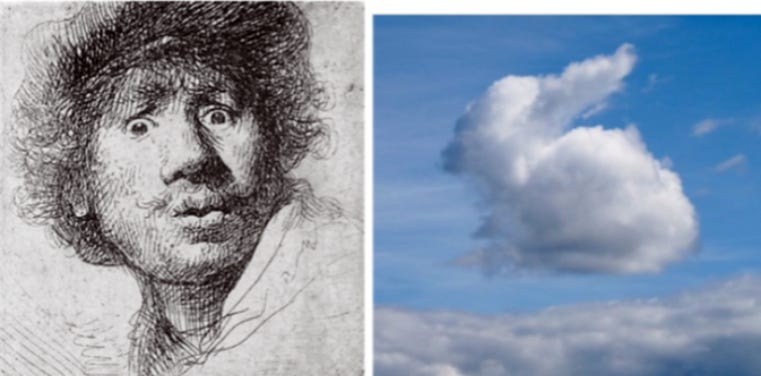
Apophenia has clear evolutionary benefits. It helped our ancestors make rapid judgments under uncertainty, often erring on the side of caution for self preservation. If you hear a strange sound in the middle of the night, your mind may immediately jump to the possibility of an intruder. This assumption is usually wrong, but evolution favors overestimating danger rather than underestimating it.
When taken to extremes, however, apophenia becomes unhealthy. Excessive pattern perception is associated with a higher risk of psychosis, including delusional thinking, and is a trait of conspiracy theorists. A core feature of paranoid schizophrenia, for example, is the perception of meaning, intention, or connection where none exists.
Interestingly, some people, such as people on the autism spectrum, show heightened abilities to detect real, objective patterns in information, particularly in logical or technical domains. Likewise, highly intelligent and analytically gifted people are sometimes able to identify genuine structures and relationships that others miss. Fictional figures such as Sherlock Holmes and Doctor Who exemplify this extreme pattern recognition.
All of this illustrates that a cognitive trait can be neither inherently good nor inherently bad. The same underlying tendency can contribute to creativity, insight, and survival, or to error, paranoia, and mental illness, depending on degree and context. People considered healthy and mentally ill often share the same basic cognitive mechanisms.
A persistent challenge is that we all form perceptions and judgments in situations where certainty is impossible. We develop pet theories about current events, historical causes, and future outcomes without knowing whether our interpretations are valid or whether we have gone off the rails. What we can know, however, is how prone we are to seeing patterns and meaning where they may not objectively exist, and how important it is to remain aware of that tendency.
Thank you for your writings. You have a real skill in conveying complex information so that it is accessible and interesting to a lay audience.
I’m curious what you think about this- how does define whether the information is “meaningless” and therefore the pattern is not in reality, but only in perception? With the drawing and bunny cloud, it’s pretty obvious, but in large data sets, it’s often difficult to tell if it’s a pattern or random chance, especially if we don’t have all the context (and in biological systems, we often don’t).
For example, if I gave you a set of binary answers (0/1) and you saw a pattern of 0,1,0,0,0,0,0,0,1,1, you would rightfully notice a pattern and suspect that 0 is “weighted” or “favored”. But then if I told you they were coin flips, and that it was random chance, then your assumption has to be thrown out. Statistics are supposed to tell us whether something is chance or a “real” pattern, but without all the information of reality, it’s often merely an educated guess.