
Science, Hype, and Correction
How Knowledge Gets Less Wrong


Science is a system for increasing knowledge by detecting and correcting errors. Individual scientists and groups are fallible, experiments can be flawed, interpretations of findings can be biased, and entire fields can drift. What distinguishes science is not that it avoids mistakes, but that, over time, it exposes and reduces them.
Science is about skepticism. Claims are tested against evidence, challenged by others, and subjected to repeated attempts at refutation. Replication is central. A finding is not reliable until independent researchers reproduce it. When replication fails, it signals a problem in the data, analysis, or assumptions.
The Role of Media and Hype
Scientific findings are regularly distorted in public communication. Science journalist Karen L. Rudd told me that the media favors novelty and simple, clear conclusions. She said it downplays uncertainty, margins of error, and the limits of the study.
Early results are often presented as breakthroughs even when they are tentative.A single study can generate headlines that imply certainty. Later corrections receive far less attention, and the public retains the first impression. This happens across all fields.
Nutrition research repeatedly cycles through strong claims and later revisions. Eggs, coffee, and red wine have each been labeled harmful or beneficial, then reassessed. Early correlations are reported as causal conclusions. Later studies show smaller effects or more complexity.
In psychology, the “power pose” hypothesis, associated with psychologist Amy Cuddy, was widely promoted as affecting hormones and behavior. Later replication efforts failed to support key claims.
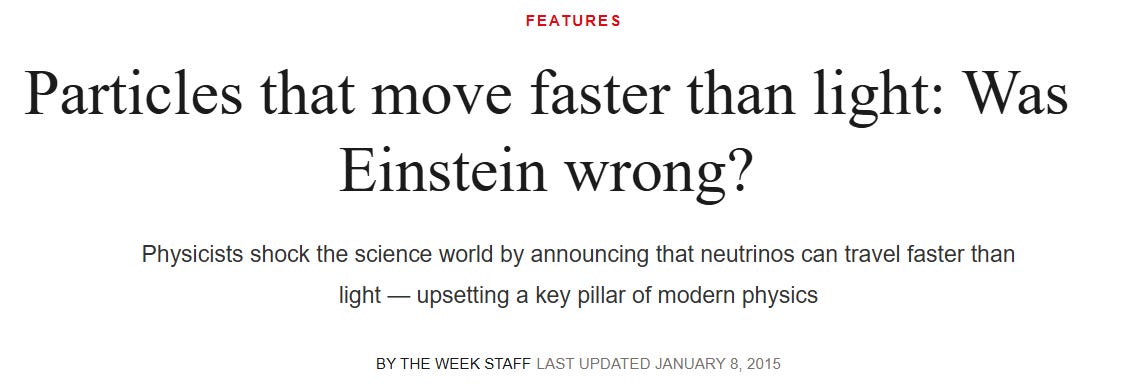
In physics, a 2011 result suggested particles can travel faster than light, challenging a foundational principle of Einstein. It was later traced to a measurement error.
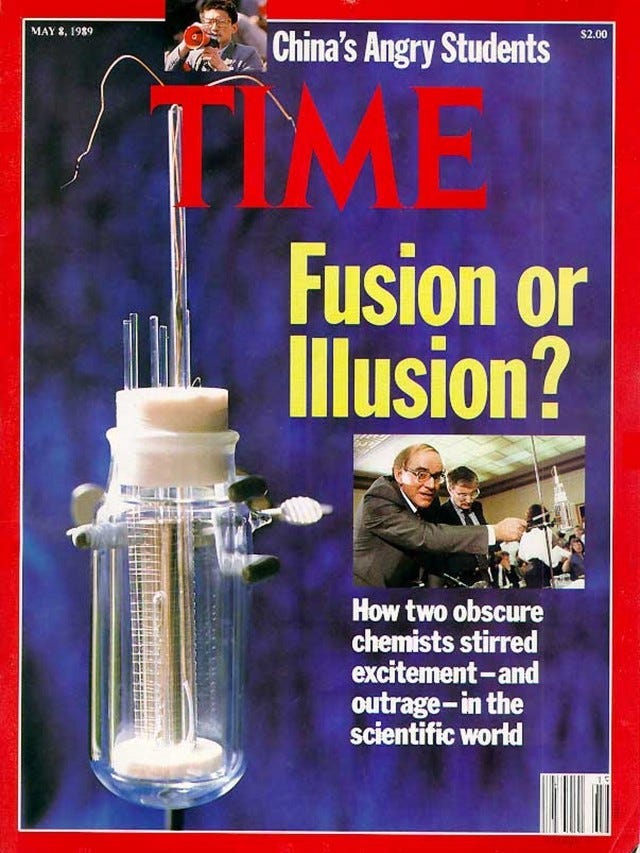
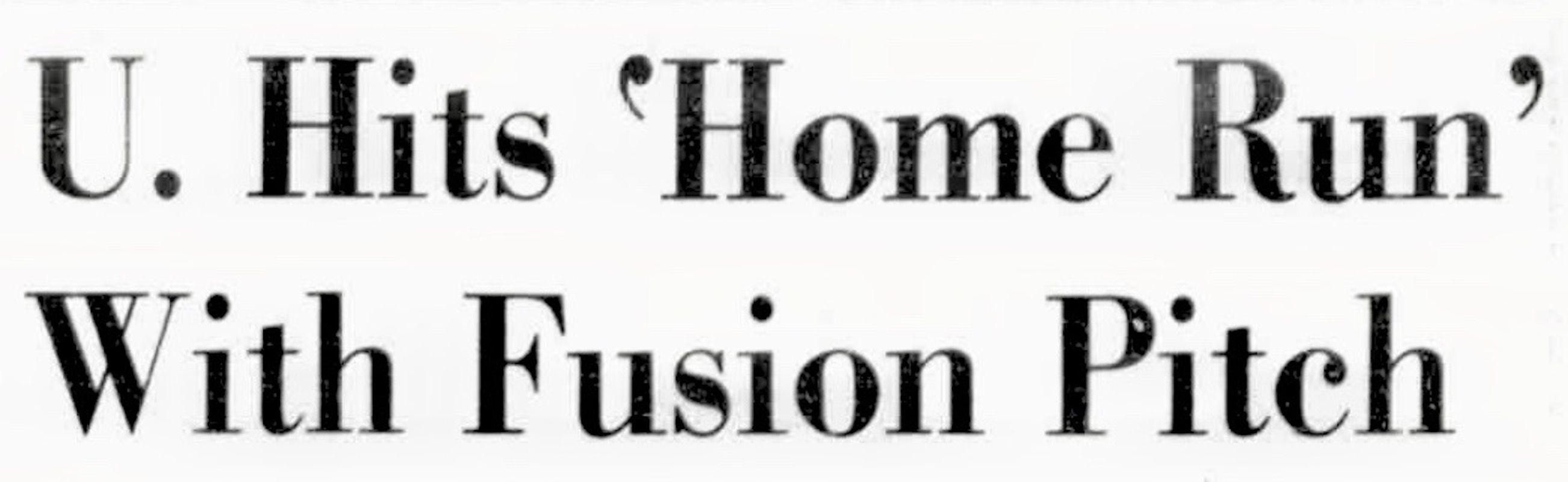
In 1989, Chemists Martin Fleischmann and Stanley Pons announced a major breakthrough in cold fusion before verification. Replication failed, and the claim soon collapsed.
Recently, microplastics research has produced claims that plastic particles are widespread throughout the human body, including the brain. Some findings are real, but measurement is highly sensitive to contamination. Airborne fibers, lab materials, and latex or synthetic gloves can introduce particles. The result is growing caution about how much microplastic is present and how confidently it can be measured.
Below are pictures of early media headlines promoting the later discredited findings.


When Scientific Organizations Overhype
The distortion does not come only from the media. Scientific institutions and some scientists themselves sometimes promote early findings too aggressively.
Jerry Coyne, a biology professor and science blogger, writes that, while hype was once mainly a problem in journalism, it is now common within the scientific community itself. Researchers and institutions sometimes overstate and prematurely publicize findings. Psychology professor Christopher Ferguson warned of “death by press release,” where universities and research organizations issue simplified summaries that downplay limitations and uncertainty.
A famous case was the 2010 “arsenic life” announcement. NASA publicized a stunning study claiming that a bacterium could replace phosphorus with arsenic in its DNA. This is a result that would have fundamentally changed biology. The study suggested that life could thrive in previously inhospitable environments, sparking widespread speculation about extraterrestrial life. The claim was promoted by NASA and the lead scientist through a major press conference, and other public events and interviews.
The reaction from other scientists was immediate skepticism. Follow-up work showed that the evidence did not support the claim. The bacterium did not use arsenic in its DNA, and the original conclusion was discredited and retracted.
The Replication Crisis
The replication crisis made these issues visible at scale. Many findings in experimental psychology and biomedicine could not be reproduced when retested. Effects weakened or disappeared under stricter conditions. In the 1990s, researchers including psychologist Brian Nosek, physician John Ioannidis, and behavioral scientist Uri Simonsohn highlighted problems with statistical practices such as data manipulation and publication bias, raising the possibility that many published findings might be false.
In the 2010s, the issue came to a head with a report showing that only about half of experimental psychology studies were reliably reproduced in later experiments.
The response was reform. Researchers adopted pre-registration, larger samples, open data, and stricter statistical standards. Replication became a priority rather than an afterthought.
The replication crisis did not show that science is a failure. It showed how, over time, science identifies and corrects errors.
What This Means
Science does not provide immediate certainty or simplistic answers. It provides a process for investigation, trial and error, and correction. The strongest conclusions are those that have survived repeated testing. The weakest are new, untested, or based on a single small study.
Science does not eliminate error. It slowly reduces it over time.
References
Psychology Today Staff. “Replication Crisis.” Psychology Today.
https://www.psychologytoday.com/us/basics/replication-crisis
McCarthy, Gregory. “Self-Correction in Science.” Yale University.
https://campuspress.yale.edu/humanbrain/self-correction-in-science/
Coyne, Jerry. “Science Finally Retracts the 2010 ‘Arsenic Life’ Paper by Felisa Wolfe-Simon et al.” Why Evolution Is True.
https://whyevolutionistrue.com/2025/07/25/science-finally-retracts-the-2010-arsenic-life-paper-by-felisa-wolfe-simon-et-al/
Coyne, Jerry. “Conference on Hype in Science.” Why Evolution Is True.
https://whyevolutionistrue.com/2014/04/25/a-conference-on-hype-in-science/
Visca, Marie. “When Science Gets Overhyped.” Dalhousie University News.
https://www.dal.ca/news/2013/12/13/when-science-gets-overhyped.html
University of Michigan. “Scientists shocked to find lab gloves may be skewing microplastics data.” ScienceDaily.
https://www.sciencedaily.com/releases/2026/03/260329222938.htm
Loncar, Tom. A Decade of ‘Power Posing’: Where Do We Stand? British Psychological Society.
https://www.bps.org.uk/psychologist/decade-power-posing-where-do-we-stand